Help to Shape Reimagined Core Writing and Math: Participation Opportunities
The Reimagining Project invites faculty, support staff, students, and community partners to help reshape these foundational courses. Whether you wish to serve on an intensive design team, contribute during a single focus group session, or share feedback through surveys, your voice is essential in building a core curriculum that prepares students for academic, career, and civic success.
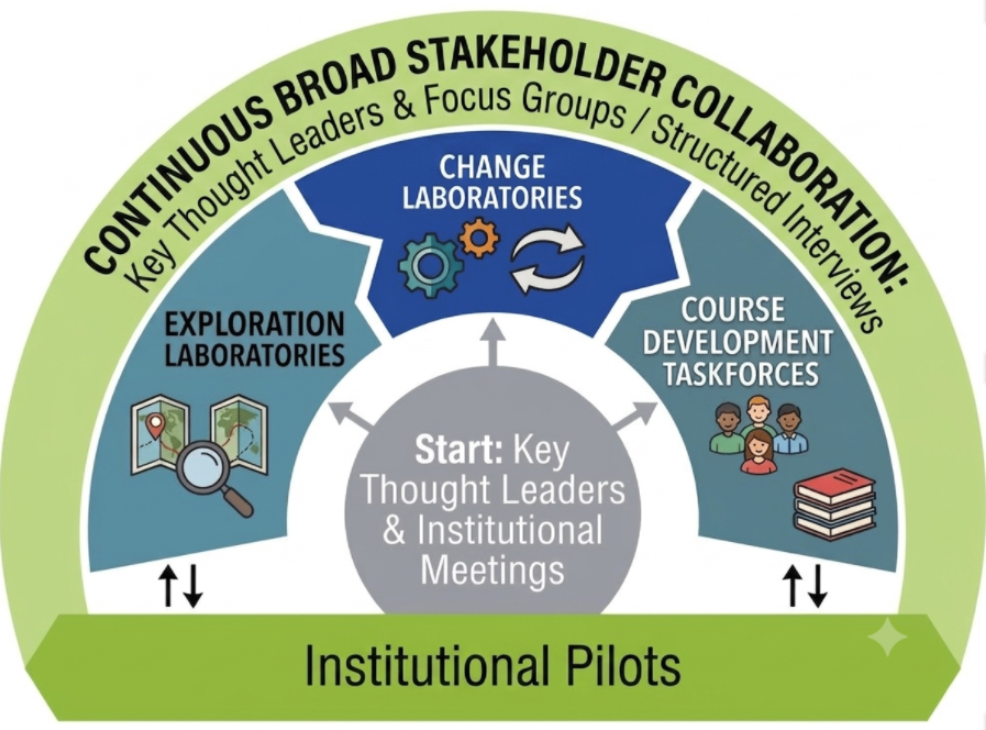
1. Focus Groups & Structured Interviews (Ongoing)
Focus Groups & Structured Interviews gather authentic stakeholder voices to uncover critical student needs, challenge academic assumptions, and identify real-world friction points before and during course redesign. Participants engage in single-session small-group discussions or structured interviews to share perspectives and lived experiences and evaluate emerging course concepts.
Representation will include students, advisors, faculty, USG CAGs/CATs (including disciplinary groups but also CATs like academic advising, career services, and teaching and learning), K-12 teachers/staff, and industry partners.
2. Exploration Labs (Spring 2027)
The Exploration Labs serve as a creative, open-discovery space where multidisciplinary teams backward-map the essential capabilities graduates need for long-term career, academic, and civic success. Participants will use the Context-Driven Elements Framework (CDEF) to identify core transfer contexts, functional abilities, technical tools, durable skills, and prerequisite schema through eight system-wide exploration labs, four in math and four in writing, organized around those subjects as a pathway to STEM, humanities, social sciences, health professions, business, education, and other professions.
Representation will include Math/English Faculty and additional faculty from STEM, Arts/Humanities, Social Sciences, Education, Health Sciences, and Business Professions as well as Professional/Career Advisors.
Apply to participate in an Exploration Lab.
3. Change Labs (Fall 2027)
Stepping into the role of strategic architects, participants in the Change Labs will translate the expansive discovery outputs from the Exploration Labs into a concrete array of course options. These teams provoke critical self-examination to establish shared course philosophies and targeted course learning outcomes.
Representation will include Math/English Faculty and other faculty from STEM, Arts/Humanities, Social Sciences, Education, Health Sciences, and Business Professions as well as instructional designers and/or assessment specialists.
Application to be released in April 2027.
4. Course Development Taskforces (Tentatively Spring 2028)
The Course Development Taskforces operationalize recommended course options from the Change Labs by turning the abstract curricular portfolios into complete, classroom-ready course blueprints. Collaborating teams of English and Mathematics faculty, corequisite instructors, instructional designers, and learning support staff construct course outlines, aligned assessment rubrics, practical teaching toolkits, and technology integration guidelines. These taskforces also establish corequisite support structures, tutoring frameworks, and faculty development pipelines for system-wide implementation.
Representation will include Math/English Faculty, including faculty who teach corequisite courses, instructional designers, and other math/English support staff (e.g., from tutoring and/or writing centers).
Application to be released in October 2027.
5. Feedback Surveys (Ongoing)
For colleagues who want to stay informed and weigh in without serving on an active committee, Feedback Surveys provide an ongoing channel to review project progress and shape final outcomes. Distributed periodically across all project phases, these surveys gather widespread input to test emerging messaging, validate draft frameworks, and build broad consensus. Your feedback ensures that recommendations developed by the design labs reflect the diverse needs and institutional realities of campuses statewide.
Representation will include students, advisors, CAGS/CATs, faculty, K-12 teachers/staff, and industry partners.
Who else is involved in this project?
Faculty are the core architects and primary drivers of this project. To support their work, a robust network of advisory bodies, institutional leaders, and project managers provide guidance and structural support.
Key Thought Leaders:
To ground and elevate faculty-led designs, these disciplinary councils, academic summits, and statewide bodies provide critical feedback and alignment throughout every stage of the redesign process.
- English CAG
- Math CAG
- Council on General Education
- Provosts
- Corequisite Academies
- Georgia Organization for Student Success (GOSS)
- Momentum Summit
Faculty & Campus Advisory Representation
The Reimagination Circle functions as a collaborative, cross-functional advisory body anchored by practicing faculty, institutional leaders, students, and other representative stakeholders. The Circle serves as a critical sounding board to guide project direction—guiding core project phases, identifying key stakeholders to engage, reviewing communication and participation plans, and addressing systemwide implementation considerations.
| Institution/Affiliation | ||
| Dr. Jann Joseph | President and Professor of Education | Georgia Gwinnett College |
| Dr. German Vargas | Provost and Vice President for Academic Affairs and Professor of Mathematics | College of Coastal Georgia |
| Dr. Jessica Lindberg | Interim Provost and Chief Academic Officer, English CAG Chair | Georgia Highlands College |
| Dr. W. Brian Muse | Department Chair and Professor of Mathematics; Representative of the Math CAG | Columbus State University |
| Dr. Danita Townsend | Executive Director, Center for Student Success and Retention | Middle Georgia State University |
| Sharon R. Duhart | Director for the Center for Academic Advising & Student Success; Representative of the Academic Advising CAT | Atlanta Metropolitan State College |
| Mandi Campbell | Director of the Institute for Faculty Excellence; Representative of the Teaching and Learning CAT | University of West Georgia |
| Dr. Sarah Kuck | Executive Director of Academics for USG eCampus / Associate Professor of Political Science | Albany State University |
| Dr. Shetia Lamar | Associate Professor of Computer Information Systems & Title IX Investigator and EEO Coordinator | Savannah State University |
| Andrea Hendricks | Associate Professor of Mathematics and Assistant Dean of Online Initiatives | Georgia State University |
| Jacari Gill | Graduate Student in Public Policy; Administrative Coordinator in USO Academic Affairs | Georgia State University / University System Office |
| Lauren Rollins | Student Government President and Senior Student in Biology | South Georgia State College |
| Cameron Largin | Sophomore Student in Agribusiness | Abraham Baldwin Agricultural College |
| Nakita Eames | Program Manager, Affordable Learning Georgia | Library Services / GALILEO |
Project Support & Operational Facilitation
Providing the administrative backbone and structural resources, this team facilitates operations, removes system-level barriers, and supports faculty as they bring this new curriculum to life.
| Name | Title |
| Melanie Largin | Assistant Vice Chancellor for General Education and Student Pathways |
| Aimee Berger | Director of Student Success Strategies |
| Duane Day | Associate Vice Chancellor of Academic Strategy and Analytics |
| Jonathan W. Hull | Associate Vice Chancellor for Student and Faculty Success |
| Laura Lynch | Associate Vice Chancellor of Academic Programs and Policy |
| Jennifer Palmer | Associate Vice Chancellor for Digital Learning & Technology |
ReImagining Team
Contact Us
Aimee Berger
aimee.berger@usg.edu
Duane Day
duane.day@usg.edu
Jonathan Watts Hull
jonathan.hull@usg.edu
Melanie Largin
melanie.largin@usg.edu
Laura Lynch
laura.lynch@usg.edu
Jennifer Palmer
jennifer.palmer@usg.edu