Reimagining First-Year Composition
Ghosts of the Past
Created at Harvard in 1874, as a response to the disappointing results of the newly created English Composition area of their Admissions Exam, the course titled "English A" was the small seed from which would grow “the most required, most taught, and thus most taken course in U.S. higher education.
From 1885 on, First-Year Compostion (FYC) has “accounted for more credit hours than any other in the U.S. postsecondary curriculum.” Current estimates indicate 2.4 to 2.8 million students enroll in an FYC course each year in the United States; here in the USG, Fiscal Year 2025 saw enrollments of 99,392 across ENGL 1101/1102.
While a sense of FYC as a foundational academic requirement has endured, pedagogies and theories about what that requirement means, the PURPOSE of FYC, have shifted dramatically over time.
| Period | Dominant Label(s) | Pedagogical Emphasis |
|---|---|---|
| Late 19th c.–1910s | Freshman English; Composition | Correctness, grammar, sentence-level form |
| 1910s–1930s | Current-Traditional Rhetoric | Product-oriented writing; fixed forms (e.g., theme, 5-paragraph essay) |
| 1940s–1950s | Rhetoric & Composition; Rhet/Comp | Skills-based instruction; correctness; clarity |
| 1960s–early 1970s | Freshman Composition | Developmental models; attention to student error |
| Late 1970s–1980s | Process Pedagogy | Writing as recursive process; revision; peer response |
| Late 1980s–1990s | Rhetoric & Composition; Composition Studies | Social construction of writing; discourse communities |
| 1990s–2000s | Writing Studies; First-Year Writing (FYW); First-Year Comp (FYC) | Genre awareness; rhetorical flexibility; transfer preparation |
| 2000s–2010s | FYW; FYC; Writing About Writing (WAW) | Metacognition; writing studies content; transfer |
| 2010s–present | FYW; Multimodal Composition | Multimodality; "social turn" – analyze how language is used to create and maintain power structures |
Its original, stated purpose (Harvard, 1874) was remediation: “providing rudimentary instruction in grammar and mechanics” for students who had not attended a preparatory school. This deficit-view implicit in this legacy still lingers in many cases, though over the years, FYC has undergone many changes in pedagogical emphasis and instructional approach.
The most recent report of the American Academy of Arts & Sciences found the average English department is made up of 27 faculty. Most likely, there are significant differences in their orientation to and training for teaching in the discipline. Even within a single department, there are likely to be many different approaches to these courses.
Current Institutional Landscape
So, the fact that we find differences between institutions is hardly surprising.
A recent system review evaluating learning outcomes across USG institutions highlighted some of the divergence:
- Commonality in Outcomes: Only 7 institutions share identical learning outcomes for ENGL 1101, and only 5 institutions for ENGL 1102. While 12 institutions share a common catalog course description, actual classroom execution varies wildly. Further, these varying approaches present a challenge when trying to align these college courses with high schools so that students can get dual enrollment credit.
- Not every student takes ENGL 1102: Students pursuing career associate degrees take a smaller general education curriculum, typically 20-30 credits, to allow for a focus on workforce competencies. Career associate degrees in the USG are mostly in allied health fields, but also in aviation and culinary arts. Eighteen career associate programs require ENGL 1101 only.
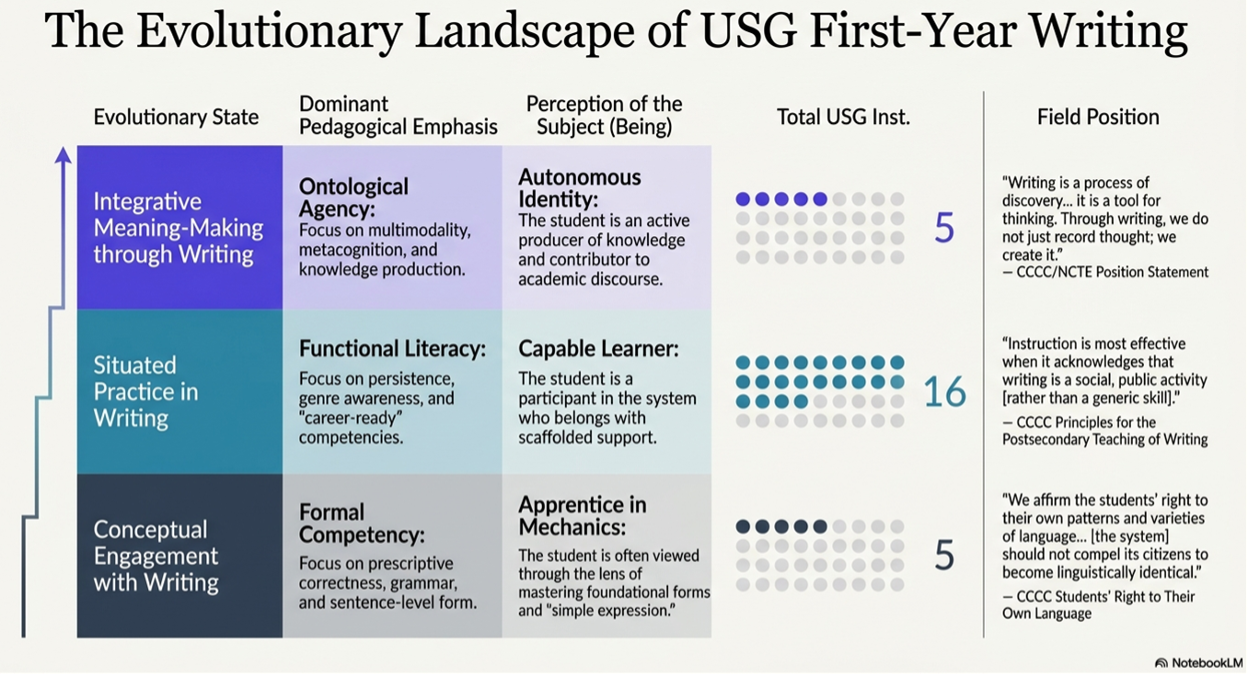
The extreme disruption brought by the near ubiquity of Generative AI (with undergraduate generative AI utilization reaching an astonishing 95% in 2026) has presented a unique opportunity for reflection and the impetus for reimagining.
The Pedagogical Challenge: Define what first-year writing should accomplish in plain, modern terms positioning composition not as an isolated skill, but as a transferable vehicle for critical inquiry and knowledge production.
ReImagining Team
Contact Us
Aimee Berger
aimee.berger@usg.edu
Duane Day
duane.day@usg.edu
Jonathan Watts Hull
jonathan.hull@usg.edu
Melanie Largin
melanie.largin@usg.edu
Laura Lynch
laura.lynch@usg.edu
Jennifer Palmer
jennifer.palmer@usg.edu